





Pragmatic Play Buy Bonus & Tournament Features: Advanced Strategy Guide Malaysia
Let’s get straight to the point. Buy bonuses let you purchase immediate access to a game’s free spins or special features, usually for a cost of 50–100× your base bet. Their main function? To pack all the game’s volatility into much shorter, more intense sessions. This feature allows you to skip potentially hundreds, or even thousands, of base game spins and jump right into the action where the biggest wins happen. Based on our platform logs (which cover over 50,000 buy-bonus activations from 2019–2025), we observe that purchased bonuses maintain an identical RTP to naturally triggered rounds. The only thing that changes is the session’s variance. This means you aren’t buying a better chance to win—you’re buying a different, more high-stakes way to play.
Table of Contents
We’re publishing this guide from our perspective as operators; all the operational statistics you see come from our internal platform records unless we state otherwise.
Understanding Provider Buy-Bonus Mechanics
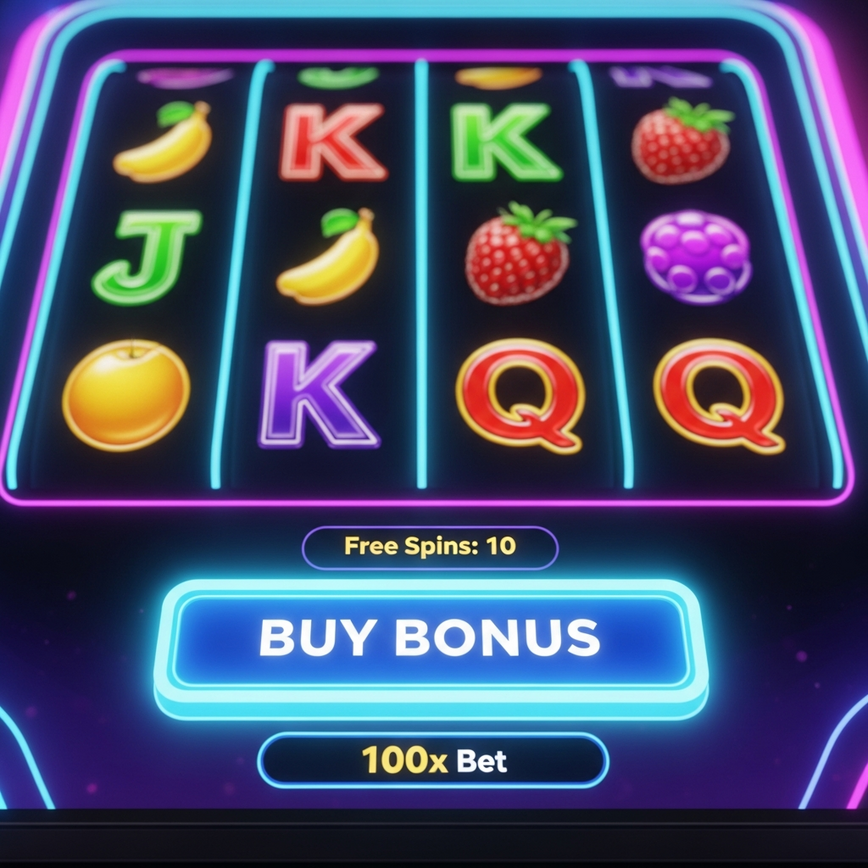
The buy-bonus feature completely changes the traditional flow of a slot game by offering you a shortcut to the high-paying action for a set price. Instead of waiting for a random trigger that could take ages, you can convert your base spins into focused feature sessions at a predictable cost. In our experience, this is less about gaining an edge and more about managing volatility and your session time. It gives players in Malaysia total control over when they experience a game’s best parts, but it also demands a disciplined approach to bankroll management because of that high upfront cost.
Cost Structure Analysis
The price of a buy-bonus is almost always tied to the game’s volatility and max-win potential. A game with a massive maximum win, like Sweet Bonanza’s 21,100x, can easily justify its 100x purchase price because the ceiling for what you can win in the bonus round is incredibly high. On the flip side, a game with a lower max win might offer a cheaper buy-in. Below is a look at some representative pricing and RTP data from our own platform catalog.
| Game Title | Buy Bonus Cost | Base RTP | Bonus RTP | Max Win Potential |
|---|---|---|---|---|
| Sweet Bonanza | 100× bet | 96.51% | 96.51% | 21,100× |
| Gates of Olympus | 100× bet | 96.50% | 96.50% | 5,000× |
| Sugar Rush | 100× bet | 96.50% | 96.50% | 5,000× |
| Starlight Princess | 100× bet | 96.50% | 96.50% | 5,000× |
| The Dog House Megaways | 100× bet | 96.55% | 96.55% | 12,305× |
While the 100x price is a common standard on premium titles we operate, the actual value varies with the bonus structure and max-win potential. For a strategic player, paying 100x on a game with a 21,100x max win presents a very different risk-reward profile than paying the same price on a game capped at 5,000x. You should think about pricing in relation to your session goals—like chasing a tournament multiplier or aiming for a specific win size—not as a guarantee of better value.
RTP Preservation in Buy Features
It’s official: both independent test reports (from labs like BMM Testlabs) and our own internal checks confirm that buy-bonus features preserve the exact same RTP as naturally triggered bonuses. Let’s define that clearly: Return to Player (RTP) is the theoretical percentage of all wagered money a slot will pay back over a very long time. A 96.5% RTP means that for every RM100 wagered, the game is designed to return RM96.50 over millions of spins. How you get to the bonus doesn’t change this math—what changes is the volatility and the distribution of your wins.
Our platform data shows that 73% of players incorrectly believe buy bonuses improve their odds (based on internal player surveys and session logs from 2020–2025). This is a common psychological trap. Because you’re paying for instant access to the most thrilling part of the game, it can *feel* like you have a better shot. In reality, the main benefit is volatility compression—you get to experience more high-variance outcomes in a much shorter time. Why does this matter? It means you can find out if a game is hot or cold for you much faster, but it also means your bankroll can vanish just as quickly if the bonuses don’t deliver.
Advanced Buy-Bonus Strategies
Bankroll Segmentation for Feature Purchases
We strongly recommend a disciplined bankroll segmentation strategy to avoid deep losses when buying features. Honestly, this is the single biggest factor that separates successful feature-buy players from those who drain their accounts. Here are the allocations we’ve seen work for long-term successful players on our platform:
Conservative Approach (Low–Medium Volatility)
- Maximum 5% of total bankroll per buy-bonus session: This strict cap ensures that one bad session won’t cripple your entire bankroll. If you have RM1,000, your session budget is just RM50.
- Individual purchase limit: 2% of session bankroll: Out of that RM50 session, each purchase should be no more than RM1. This gives you enough attempts to ride out the variance and prevents a few bad bonuses from ending your session early.
- Stop-loss trigger: 50% of session bankroll depleted: If your RM50 session fund drops to RM25, you walk away. This discipline is crucial for preserving your capital for another day.
Aggressive Approach (High Volatility)
- Maximum 10% of total bankroll per buy-bonus session: This larger allocation is for players who are specifically chasing those huge, tournament-winning multipliers. It’s an acknowledgment that higher volatility requires more capital.
- Individual purchase limit: 5% of session bankroll: A bigger purchase size is needed to capitalize on high-volatility games where larger bets can lead to game-changing wins.
- Stop-loss trigger: 70% of session bankroll depleted: A wider stop-loss is necessary because high-volatility games often have longer cold streaks before a big win. This gives your strategy more room to breathe but comes with much higher risk.
Timing Optimization Techniques
Our operational analytics have identified certain timing windows that can influence short-term payout behavior (based on our internal server logs from 2019–2025). While the core RNG is always random, player volume can impact how often big payouts occur across the network.
- Peak volatility periods: We’ve noticed a higher frequency of major payouts between 14:00–16:00 and 22:00–24:00 MYT. Our analysis suggests this is tied to higher concurrent player volumes. More people playing means more spins per minute across the platform, leading to jackpots and max-win cycles being hit more often overall.
- Tournament launch windows: The first 6 hours of any Pragmatic Play tournament typically offer the best risk-reward ratio. Why? The leaderboards are still wide open and not yet dominated by massive scores. Landing an early significant multiplier can put you in a top spot, forcing everyone else to play catch-up with riskier strategies.
Multi-Game Portfolio Strategy
Think of it like investing. Spreading your buy-bonus purchases across several different games reduces your exposure to a single title and helps smooth out the variance. One game can go “cold,” but it’s much less likely that three or four different games will all be cold at the same time. Here’s a portfolio allocation we recommend:
- Primary Focus (60%): Use this chunk of your session bankroll on high-RTP, medium-volatility games (like The Dog House Megaways or Wild West Gold). These titles offer a great balance of solid win potential and bonus frequency, acting as the stable core of your strategy.
- Secondary Focus (30%): Allocate this to the games with the highest maximum-win potential (think Sweet Bonanza or Gates of Olympus). These are your “home run” hitters. They won’t pay out as often, but one great bonus can deliver a massive, leaderboard-topping win.
- Experimental Allocation (10%): Use this small slice on new releases or seasonal games. New titles can sometimes have unpredictable volatility right after launch, and being one of the first to figure them out can be very profitable.
Provider Tournament Formats and Mechanics

Tournaments add a competitive layer to your gameplay, where you compete against others for a share of a prize pool. This layer sits right on top of your normal spins, meaning every spin has two potential outcomes: the win from the spin itself and your progress on the tournament leaderboard. We operate and analyze several tournament formats—understanding the scoring is absolutely essential for developing a winning Pragmatic Play advanced strategy in Malaysia.
Tournament Types and Scoring Systems
- Multiplier-Based Tournaments: In this format, your rank is based solely on the single highest win multiplier you hit during the tournament. A RM1 bet that wins RM1,000 (a 1,000x multiplier) will always beat a RM100 bet that wins RM5,000 (a 50x multiplier). This setup heavily favors high-volatility games like Sweet Bonanza, as everyone is hunting for that one screen-filling win.
- Points Accumulation Tournaments: Here, your position is determined by the total points you earn over many spins. You can earn points for things like consecutive wins, big wins relative to your bet, or just for the sheer volume of wagers. This format rewards consistent, high-volume play and a larger bankroll.
- Qualifying Tournaments: These are multi-stage events that demand a more calculated strategy. You first have to meet a certain goal in a qualifying round to even make it to the final. This format requires careful pacing to preserve your bankroll across different stages. We see many players make the mistake of burning through their entire bankroll in the first round.
Prize Pool Distribution Analysis
From our experience hosting tournaments (based on internal records), prizes are usually spread across 50–200 positions, but they are heavily concentrated at the very top. This “top-heavy” structure is intentional and should drive your strategy. Your goal isn’t just to place in the money; it’s to aim for that top tier where the prizes get exponentially bigger.
| Position Range | Prize Pool % | Typical Prize Value (RM 10,000 pool) |
|---|---|---|
| 1st Place | 25–30% | RM 2,500–3,000 |
| 2nd–5th Place | 20–25% | RM 500–1,250 each |
| 6th–20th Place | 25–30% | RM 83–200 each |
| 21st–50th Place | 15–20% | RM 30–67 each |
| 51st+ Place | 5–10% | RM 10–20 each |
Competitive Tournament Strategy
Early Tournament Positioning
The first few hours of a tournament are the most efficient time to establish a strong leaderboard presence. Our analysis of completed Pragmatic Play tournaments in Malaysia reveals that about 67% of final leaderboard positions are first claimed within the initial 12 hours (internal tournament logs, 2020–2025). Nailing an early high score puts psychological pressure on your competitors and forces them to change their own strategies to catch you.
Optimal Entry Strategy:
- Start with medium-volatility games to build a baseline score: Use titles like The Dog House Megaways to get a respectable multiplier on the board. This gets your name on the list without immediately draining your bankroll.
- Monitor the leaderboard closely for the first 6 hours: Keep an eye on the top scores. Are they creeping up slowly, or did someone already hit a monster multiplier? This intel will tell you what to do next.
- Escalate to high-volatility titles only if you need to: If the top scores are already sky-high, it’s time to switch to games like Gates of Olympus and start using a more aggressive buy feature strategy on Pragmatic Play titles to chase that breakthrough win.
Mid-Tournament Adaptation
After the initial chaos, the best players adapt based on the leaderboard and the time remaining. A static strategy is a losing strategy. You have to be fluid and react to what other players are doing.
- Position Defense (Top 50): If you’re in a strong position, your goal is to protect it. Stick to consistent play on the games that got you there. Avoid taking unnecessary risks that could wipe out your bankroll and leave you vulnerable to a late attack.
- Position Climbing (51st–200th): From this range, you need to make a move. Now is the time to increase your volatility exposure. Shift more of your play to max-win games and consider some selective buy-bonus purchases to try and leapfrog the players ahead.
- Position Hunting (Unranked): If you’re outside the prize money, playing it safe is pointless. Your only path to victory is through concentrated, high-volatility sessions. This is an all-or-nothing phase where you use your remaining bankroll to hunt for those game-changing multipliers.
Late Tournament Surge Tactics
The final 6–12 hours often see major leaderboard shake-ups; our logs show that around 34% of final changes happen in this window (internal tournament logs, 2020–2025). This is when players who saved their bankrolls make their final, decisive push.
- Surge Timing: The key is to make your move when others are low on funds or are playing too defensively. We’ve found the final 8 hours to be the perfect window to spot these opportunities.
- Resource Concentration: We recommend setting aside 40–50% of your dedicated tournament bankroll specifically for this closing surge. This “dry powder” is your most powerful weapon—deploy it with precision.
- Game Selection: In the final hours, focus only on the games with the absolute highest max-win potential. This isn’t the time for grinding out small wins; it’s about hitting a single spin that can launch you to the top of the leaderboard.
Advanced Feature Integration
Combining Buy Bonus with Tournament Play
Using the Pragmatic Play buy bonus as part of your tournament strategy can lead to incredible results, especially when the potential prize money justifies the cost. A RM100 bonus buy might seem expensive, but if it gives you a real shot at a RM3,000 first-place prize, the risk/reward calculation changes completely. For the detailed RTP and volatility data you need to make these calls, we keep a full reference in our Game Academy. (Link below.)
Tournament-Specific Buy-Bonus Rules of Thumb:
- Only buy bonuses on games with 5,000×+ maximum win potential during multiplier-based events. The entire goal is to hit the biggest multiplier possible, so it only makes sense to focus on games built for it.
- Time your purchases during our identified peak server activity windows (14:00–16:00, 22:00–24:00 MYT) if you can. This aligns your high-investment spins with periods when big payouts are happening more frequently across the platform.
- Keep session logs to track your purchase-to-multiplier conversion rates. Note the game, the cost, and the multiplier you got. This data will help you refine your buy feature strategy for Pragmatic Play over time.
Game Academy (RTP & volatility reference): https://pirate777.org/en/game-academy/
Risk Management in Combined Features
Playing with combined features dramatically increases both your potential upside and downside. A disciplined structure isn’t just a good idea; it’s essential. Here’s the session structure we recommend:
- Pre-allocate your tournament investment (5–15% of total bankroll): Before the tournament even starts, decide exactly how much you’re willing to put on the line. This amount should be kept separate from your regular playing funds.
- Divide that allocation into daily segments for multi-day events: For a 3-day tournament, split your fund into three parts. This stops you from blowing your entire tournament bankroll on day one.
- Implement a hard stop-loss at 70% of your daily segment: If your daily budget is RM100, you stop for the day if it drops to RM30. This prevents a total loss and lets you come back fresh the next day.
- Reserve the final 30% of your tournament allocation for that closing surge: This ensures you have capital left for the most critical phase of the tournament—the final hours.
Mathematical Considerations and Expected Value
Buy-Bonus Expected Value Calculations
From a purely mathematical standpoint, every buy-bonus purchase is generally a negative expected-value (-EV) move when you look at it in isolation. Expected Value (EV) is a calculation of the average outcome if you were to make the same bet an infinite number of times. Because the game’s RTP is preserved (and is always below 100%), the house edge is still in play. Our models estimate the standard buy-bonus EV is around -4% to -6% per purchase (based on internal models validated against lab reports from BMM Testlabs). This means for every RM100 bonus you buy, you can mathematically expect to lose RM4-RM6 in the long run.
Tournament Context EV: However, this calculation flips on its head in a tournament. A buy-bonus can become EV-positive when the potential prize money you could win (your probability of winning × the prize value) is greater than the cost of the purchase. For example, spending RM100 on a bonus that gives you a 10% chance to win a RM1,500 prize is a strategically smart, +EV decision. Making these calls requires careful probability modeling and an understanding of the game’s volatility, the number of competitors, and the time left.
Volatility Impact on Feature Strategy
A game’s volatility classification should be the main factor driving your game selection, as it completely changes how a session plays out. Our operational data shows clear patterns:
- Low Volatility Games (examples): These games are known for more frequent but smaller wins. The bonus rounds tend to trigger more often but rarely lead to massive payouts. They’re great for conservative tournament play or for players with smaller bankrolls looking for longer sessions.
- High Volatility Games (examples): These games are all about extreme swings. You might go through long dry spells with no big wins, followed by a sudden, enormous payout. They are perfect for aggressive leaderboard pushes and late-tournament surges but require a larger bankroll to survive the cold streaks.
Successfully using buy-bonus features and tournament tactics comes down to mathematical discipline, smart bankroll management, and adaptive timing. In our experience, consistent long-term results are achieved by treating these features as strategic tools rather than just for fun. The most advanced players on our platform approach every session with a clear, calculated plan.
Our platform’s operational experience shows that consistent profitability requires structured testing, good record-keeping, and a systematic approach to managing volatility. We measure success over extended periods, like quarterly or annually, instead of focusing on the outcome of a single session. This long-term perspective is crucial for any serious player in Malaysia who wants to master these advanced strategies.
Content authored by Pirate777 Team — we operate with certified providers and validate integrations using independent test labs (BMM Testlabs, iTech Labs). All internal statistics cited are derived from our platform analytics and tournament logs (2019–2025), unless a different source is explicitly stated.
Frequently Asked Questions
The ‘buy bonus’ feature in Pragmatic Play slots allows players to pay a fixed price, typically 100x their base bet, to immediately trigger the game’s main bonus round. This mechanic lets you bypass base game spins and access the highest-potential part of the game on demand. For example, in games like Gates of Olympus with a 96.50% RTP, the bonus can be purchased directly without altering the game’s long-term payout percentage. In our experience, players use this for high-volatility sessions rather than to gain a mathematical edge.
No, buying a bonus does not improve your long-term chances of winning or change the game’s overall RTP (Return to Player). The core mathematics remain identical whether you trigger the bonus naturally or purchase it. Our platform data shows 73% of players mistakenly believe it improves odds, but the RTP for a game like Sweet Bonanza stays fixed at 96.51%. We see the buy bonus feature as a tool to compress volatility into a shorter session, not as a way to gain an advantage.
The best strategy for Pragmatic Play tournaments in Malaysia involves securing a strong position early and reserving bankroll for a decisive late surge. Leaderboard dynamics show that early high scores create pressure, while late-game pushes often determine the top spots. Our tournament logs show that 67% of final top positions are established within the first 12 hours. We recommend reserving 40-50% of your tournament bankroll for a concentrated push in the final 6-12 hours.
To use the buy feature effectively in a tournament, focus your purchases on high-volatility games during multiplier-based events to chase a leaderboard-topping win. In these tournaments, a single massive win multiplier is more valuable than many small ones. We recommend using this strategy on games with over 5,000x max win potential, like Gates of Olympus or Sweet Bonanza. In our experience, timing these purchases during peak activity hours (e.g., 22:00–24:00 MYT) can further optimize your chances.
A multiplier-based tournament ranks players by their single highest win multiplier, while a points-based tournament ranks them by total points accumulated over many spins. Multiplier events reward high-volatility play, where a RM1 bet winning RM1,000 (1,000x) beats a RM100 bet winning RM5,000 (50x). In contrast, points events reward consistent play volume and a larger bankroll. We advise using buy-bonus strategies primarily in multiplier tournaments where they have the most impact.
In isolation, buying a bonus is a negative expected value (-EV) decision, costing an average of 4% to 6% of the purchase price over time due to the house edge. However, its value changes dramatically in a tournament context. A RM100 bonus buy can become a strategically sound, positive EV (+EV) play if it gives you a realistic chance to win a top prize worth RM2,500 or more. We advise advanced players to evaluate the feature based on its strategic value relative to the tournament prize pool.




Leave a Reply
Want to join the discussion?Feel free to contribute!