


How Independent Labs Test Online Slots for Fairness: BMM, iTech Labs & GLI Explained
Last Updated: July 17, 2026
When a slot is described as “certified fair”, it usually means an independent testing lab has examined its random number generator (RNG) and confirmed the game behaves the way its maths says it should. This guide explains what that testing actually involves — who the labs are, how they test, and, just as importantly, what a certificate does and doesn’t cover.
For the bigger question of how to judge whether a whole platform is trustworthy, see our guide on how to tell if a Malaysian online casino is actually trustworthy — lab certification is only one piece of that.

What independent testing labs do
Independent testing laboratories assess the fairness and technical integrity of a game’s software. They operate separately from the studios that build the games and the operators that host them — that independence is the whole point. Their core work:
- Testing the RNG for statistical randomness and unpredictability.
- Verifying the game’s mathematics, including that the published return-to-player (RTP) matches actual long-run outcomes.
- Checking software integrity and anti-tamper measures.
A certificate is issued for a specific version of a specific game. It is not a blanket stamp on a platform, a provider’s whole catalogue, or anything beyond the game engine tested.
The three labs you’ll see most often
| Lab | Background | Focus |
|---|---|---|
| BMM Testlabs | One of the longest-established gaming test labs | Mathematical RNG analysis, RTP verification |
| iTech Labs | Australia-based; tests online and mobile games | RNG plus device/browser performance |
| GLI | Operates across many jurisdictions | Automated and manual RNG and systems testing |
All three are genuine, well-established labs. Whether any individual game carries one of their certificates depends on the studio behind it — the lab certifies the game engine, not the platform, and the studio’s own documentation is where a specific certificate can be confirmed. (iTech Labs vs GLI, compared →)
How the RNG testing process works
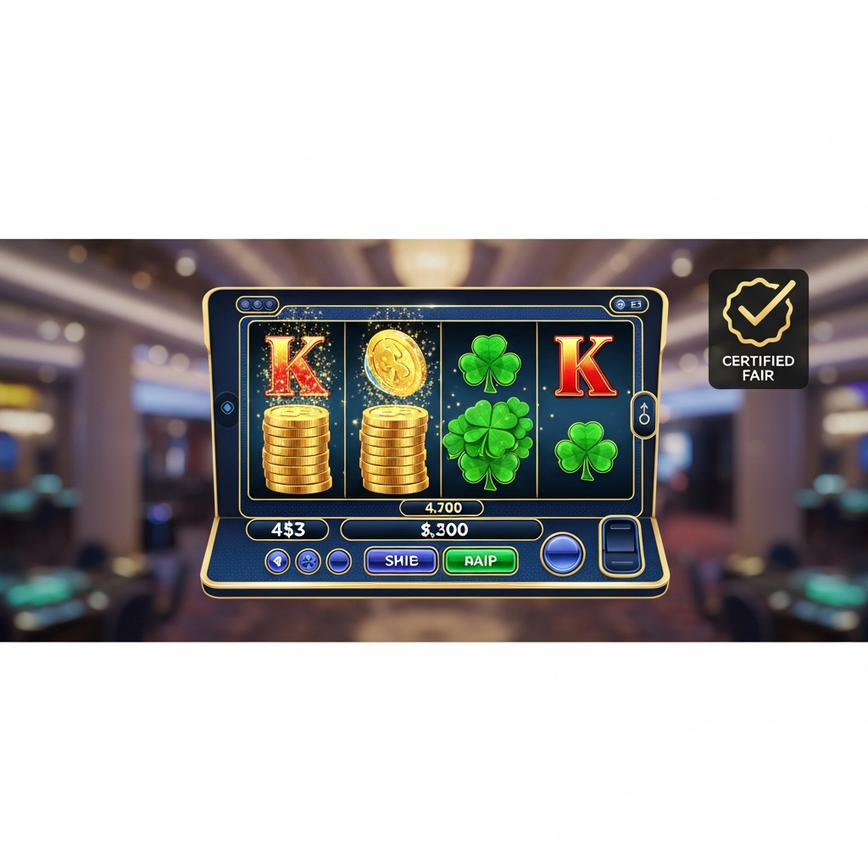
- The studio submits the game’s source code — specifically the RNG and prize-allocation logic — to the lab.
- The lab runs millions of simulated rounds to confirm the actual outcome distribution matches the declared mathematical model.
- It checks the RNG against standard statistical randomness tests (chi-squared, runs tests and similar).
- If the game passes, the lab issues a certificate. If it fails, the studio has to fix it and resubmit.
The process re-runs whenever a studio materially changes a game’s maths — it’s tied to the version, not a one-time badge.
What certification does NOT cover
This is the part most “certified” claims leave out. RNG certification is narrow. It does not cover:
- Payment processing — deposits and withdrawals are platform operations.
- Account security — KYC, login and account access are the platform’s responsibility.
- Promotional terms — bonuses and wagering rules are not certified.
- Operator licensing — a game certificate says nothing about whether the platform holds any licence.
- Your individual results — certification proves long-run fairness, not any single session.
If a site claims something is “certified” beyond a game’s RNG fairness — a “certified secure platform”, a “certified fair operator” — the mark is being used for something it was never issued for.
How to check a game’s certification
If a specific title’s fairness matters to you: note the studio, then check that studio’s own published documentation or the lab’s certificate lookup (for example, GLI exposes individual certificates at access.gaminglabs.com/Certificate). A studio that’s genuinely licensed by a regulator is also verifiable on that regulator’s register — a stronger signal than a lab logo alone. (How to actually judge a platform’s trustworthiness →)
FAQs
It means the game’s maths and randomness were independently tested and found fair. It says nothing about the operator’s payments, security or licensing — so it’s one signal, not a full safety guarantee.
No. Whether a game is lab-tested depends on the studio that made it. Some studios’ games are verifiably certified; others aren’t — a “certified” label on a site isn’t proof by itself.
Often, yes — labs publish their certification scope, and some (like GLI) offer a per-certificate lookup. The studio’s own documentation is the most direct source for a specific title.