



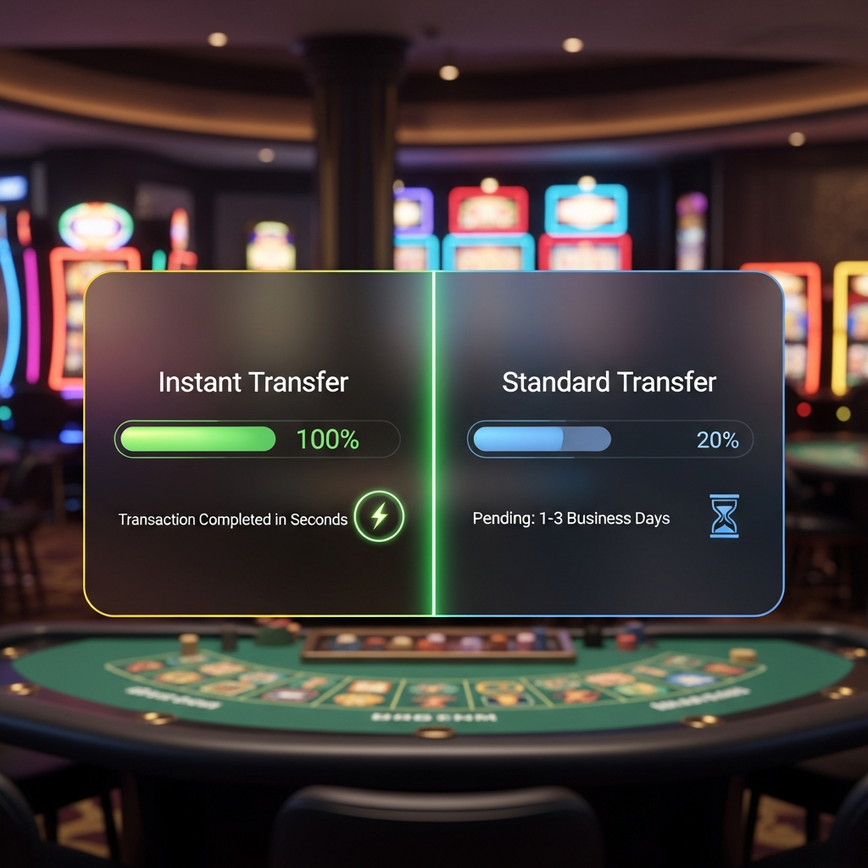
DuitNow vs Bank Transfer: Which Payment Method is Faster?
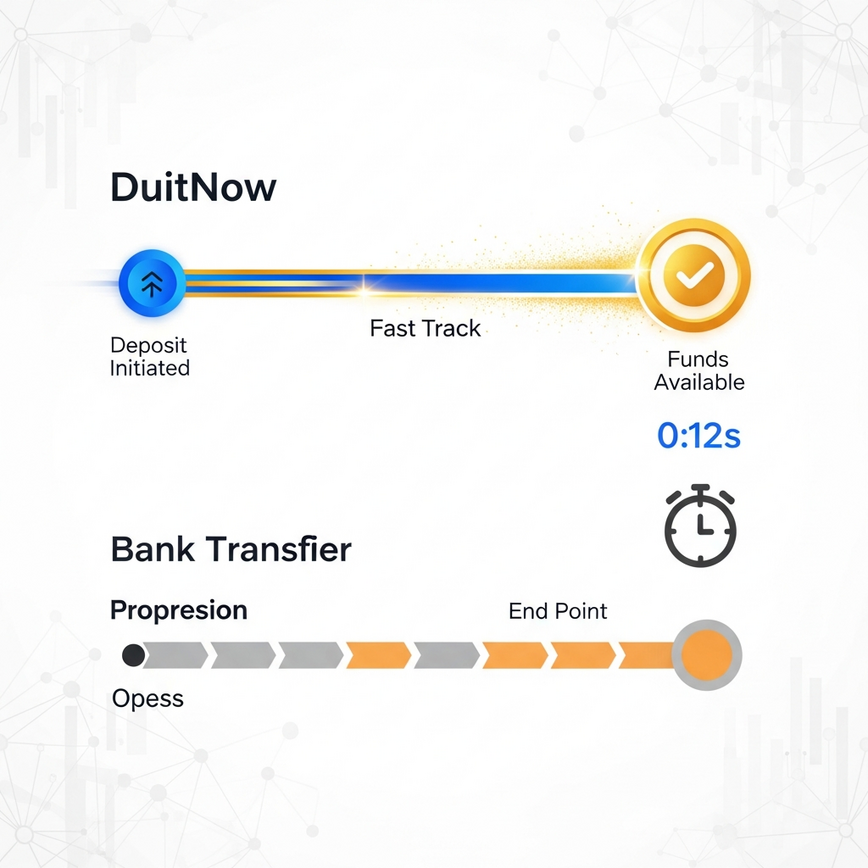
DuitNow is faster because it settles in real time, 24 hours a day, while a traditional interbank transfer (IBG) clears in scheduled weekday windows: sent before 5:00pm on a working day it arrives the same day, and at worst it is credited by 11:00am the next business day. The “1–3 business days” often quoted for Malaysian bank transfers does not match PayNet’s published clearing schedule — the domestic worst case is measured in hours, not days. Just as important for Pirate777 players: you never pick a rail at payout. Every withdrawal is sent as a DuitNow bank transfer to the account you registered, and our own timing puts the average at 2.3 minutes end to end. Below is the honest comparison: what actually differs between the two rails, what does not, and the few situations where a traditional transfer really is slower.
Table of Contents
- One Destination, Two Rails: What This Comparison Really Means
- The Speed Comparison, on the Published Schedule
- How a Pirate777 Payout Actually Travels
- Deposits: What the Cashier Offers and What It Costs
- When a Traditional Transfer Really Is Slower
- Security: What Actually Protects Each Rail
- What Our Numbers Can and Cannot Tell You
- The Honest Verdict
- How This Page Was Verified
One Destination, Two Rails: What This Comparison Really Means
“DuitNow vs bank transfer” sounds like a choice between two destinations, but both put money in exactly the same place: a Malaysian bank account. What differs is the rail the money rides. DuitNow Transfer runs on the Real-time Retail Payments Platform (RPP), operated by PayNet — the national payments operator whose largest shareholder is Bank Negara Malaysia. It launched in December 2018, settles transfer by transfer in real time, runs 24/7 including weekends and public holidays, and reaches every bank on the network — 42 banks nationally. In 2025 the network carried about 4.5 billion transactions worth roughly US$330 billion.
The “traditional bank transfer” in this comparison is Interbank GIRO (IBG) — the older rail that collects transfers into batches and clears them at fixed times on working days. A third case, a transfer between two accounts at the same bank, never leaves that bank’s own books and is typically immediate at any hour. So the real question this page answers is not “which destination?” but “which rail, and how long does each actually take?” For the plumbing behind the rail itself, see our DuitNow rail mechanics explainer.
The Speed Comparison, on the Published Schedule
The table below describes each rail’s published behaviour rather than invented waiting times. The short version: DuitNow settles in real time around the clock, IBG clears in five weekday windows, and neither takes “1–3 business days” inside Malaysia.
| Rail | How it settles | Operating hours | Realistic wait |
|---|---|---|---|
| DuitNow Transfer | Real time, transfer by transfer, on PayNet’s RPP | 24/7, including weekends and public holidays | Seconds once the sender releases it |
| Same-bank transfer | Internal book entry within one bank | 24/7 at most banks | Typically immediate |
| Interbank GIRO (IBG) | Batch clearing at fixed times | Five clearing windows on working days | Same day if submitted before 5:00pm on a working day; by 11:00am the next business day after 5:00pm, on weekends and on public holidays |
IBG’s exact schedule is published by PayNet and is identical at every participating bank. On a working day, a transfer submitted before 5:00pm is credited the same day in stages: before 5:00am arrives by 11:00am, 5:01–8:00am by 2:00pm, 8:01–11:00am by 5:00pm, 11:01am–2:00pm by 8:00pm, and 2:01–5:00pm by 11:00pm. Anything submitted after 5:00pm, or on a weekend or public holiday, is credited by 11:00am the next business day. That is the entire worst case — one morning’s wait, not days.
DuitNow needs no such schedule because there is no batch to wait for: the sending bank pushes the credit across the rail, the receiving bank confirms it, and the transfer is done — at 3:00pm on a Tuesday or 2:00am on a Sunday alike. International transfers sit outside both rails: DuitNow is a domestic network, and our payouts go to Malaysian accounts.
How a Pirate777 Payout Actually Travels
There is no rail menu on our withdrawal screen, and that is the point. The form, read from the live platform on 21 August 2026, asks for exactly three things: your withdrawal bank, your bank account number, and the amount — with quick-select preset buttons for RM50, RM100 and RM1,000, plus MAX. The same screen prints the limits that apply: RM50 minimum, RM100,000 maximum per transaction, and — at the entry rank — RM10,000 per day across up to three withdrawals, with both daily figures rising as your rank does (see limits and rank tiers). Every payout then travels the same way: as a DuitNow bank transfer to the account you registered.
Our payouts use DuitNow’s account-number route. Before any money moves, the receiving bank returns the registered account holder’s name for confirmation — which is why a name mismatch stops a payout rather than merely slowing it, and why the account details you register are worth checking once, carefully. Note what is absent: no QR code is involved at any point. DuitNow QR is a payment-acceptance scheme — scanning a code authorises money out of the scanner’s own account — so it cannot deliver a withdrawal, on our platform or anywhere else. We unpack that in DuitNow QR vs DuitNow Transfer.
On timing: our finance team’s own measurement puts the average withdrawal at 2.3 minutes end to end — the clock starts when winnings are verified and stops when the receiving bank credits the account. It is a daily average across all seven days of the week, taken from one-hour sessions sampled on random days and times, and it held consistent across two separate audit windows fourteen months apart (February 2025–January 2026, and again in March–April 2026). For context, our own timed tests of 98 Malaysian competitor platforms — 173 withdrawals, mystery-shopped with real deposits — found larger brands averaging around 15 minutes, mid-sized platforms 20–30 minutes, and smaller operators around 45 minutes.
Two honest caveats. Your first withdrawal takes longer than 2.3 minutes because Captain’s Support runs an identity check while that withdrawal is being processed; later withdrawals run normally. And the 2.3-minute figure covers the DuitNow rail only, which is the rail every payout already takes — the IBG windows above describe transfers you make yourself, not our payouts. The full process is in our step-by-step cash-out guide.
What if a payout does not arrive?
On this rail the causes are few and checkable. A name mismatch between your Pirate777 details and the bank account stops the payout outright rather than slowing it, because the receiving bank returns the account holder’s name before any money moves. A bank’s overnight maintenance can delay when the credit shows in its app without delaying the transfer underneath. And a request can be waiting on your own daily allowance rather than on the rail — three withdrawals and RM10,000 a day at the entry rank. What does not exist is a status tracker to refresh or a queue position to read: the real path is Captain’s Support on Telegram or live chat, staffed 24/7, who can see the request itself. Treat any “scan this QR code to collect your payout” instruction as a scam and report it to the National Scam Response Centre on 997.
Deposits: What the Cashier Offers and What It Costs
On the deposit side you do see a menu, and it is worth being precise about what is on it. When we read the live cashier on 21 August 2026 it offered e-wallet deposits, FPX Pay, and telco reload plus Touch ’n Go reload pins. FPX is the one that matters for this comparison: it is the “bank” route at deposit, and it completes inside your own bank’s online-banking login in a single sitting — it is not an IBG transfer and does not wait for clearing windows.
The minimum deposit is RM10, and we absorb processing fees in both directions: if you deposit RM100, exactly RM100 lands in your gaming account, and withdrawals are fee-free as well. One detail almost nobody notices: a deposit made with a telco reload pin (U Mobile, Celcom, Digi or Hotlink) earns a 5% bonus with no turnover requirement — claimed through our support team within 24 hours of the deposit.
What each deposit method will actually accept
Type the amount first: the cashier then shows only the methods whose band covers it, which is why a flat “minimum RM10” needs a qualifier. A Touch ’n Go, GrabPay or ShopeePay deposit runs from RM30 to RM5,000. DuitNow QR takes RM10 to RM30,000 a deposit, FPX RM10 to RM10,000, and a manual bank transfer RM30 to RM100,000 — on that last one your own bank’s daily transfer limit bites long before ours does. Cashier read 8 September 2026. Ask for RM20 and the wallet buttons simply will not appear; that is the band doing its job, not an error.
Payment methods and limits last verified 21 August 2026. We update this page when they change.
New here? What your first deposit and first withdrawal involve
You register with a mobile number — Malaysian, Singaporean or Taiwanese — or through Telegram, and the smallest opening deposit the cashier will take is RM10 on DuitNow QR, FPX or a telco reload PIN. How you deposit decides nothing about how you are paid: every withdrawal leaves on the DuitNow rail to a bank account in your own name, which is why the name on that account has to match your Pirate777 details. The extra step to expect is the identity check — Captain’s Support runs it while your first withdrawal is being processed, not at sign-up and not when you register the bank account, and our Terms allow a repeat identity check on a withdrawal above RM5,000 or past RM20,000 in any 30 days.
Does the rail you pick change your bonus or turnover?
Not on its own. Our Terms ask for a deposit to be wagered once before it can be withdrawn, whichever way the money came in — an anti-money-laundering rule rather than a promotional one. The welcome offer is identical on both rails too: deposit RM30, get RM30, with a RM180 floor and a RM300 ceiling on what that bonus itself can pay out (full bonus terms). The one deposit channel that carries a bonus of its own is neither of these rails: a telco reload PIN adds 5% to the deposit with no turnover attached, claimed through support within 24 hours, and it cannot be combined with any other deposit bonus.
When a Traditional Transfer Really Is Slower
The honest cases where the traditional rail costs you real time are narrow and specific. The big one is the Friday-evening IBG transfer: submitted after 5:00pm on a Friday, it is credited by 11:00am on Monday. That is the closest thing Malaysia has to the “days-long bank transfer” — and it is still one weekend, not 1–3 business days. The same next-business-day rule applies to public holidays. DuitNow has no equivalent case at any hour.
What is not slower: the receiving bank. Every bank on the DuitNow network receives on the same real-time rail, so there is no “fast bank” or “slow bank” for a DuitNow credit. The per-bank differences that do exist — transfer limits, overnight app-maintenance windows — are covered in processing times by bank. A bank’s own overnight maintenance can delay when a credit becomes visible in its app, but that is a display delay, not a rail delay.
Limits are where the rails genuinely differ. IBG allows up to RM50,000 per day through digital channels and RM500,000 over the counter. Banks also cap DuitNow transfers — Maybank and CIMB, for example, allow up to RM50,000 per day, shared with IBG. Our own platform caps sit below all of these at the entry rank — RM10,000 per day, rising with rank, and RM100,000 per transaction — so in practice the platform cap, not the rail, is what most players meet first.
Security: What Actually Protects Each Rail
Both rails run under Bank Negara Malaysia’s payment-system oversight, and both are operated by the same body, PayNet. Neither is “more regulated” than the other, and neither is safer across the board — the protections are simply different in shape.
The DuitNow protection that matters most in practice is the name check: before the sender confirms a transfer, the receiving bank returns the registered account holder’s name, so money does not move to an unverified destination. Transfers are approved inside your own banking app, and banks apply a cooling-off period to transfer-limit increases — Maybank’s, for example, is 12 hours — which blunts a common scam pattern. On our side, every transaction is carried over 256-bit SSL encryption; more on the rail’s protections in DuitNow safety and security.
One rule keeps you safe on any rail: receiving money never requires you to scan anything. If any site tells you to scan a QR code to collect a payout, stop — scanning authorises a payment out of your account. Malaysia’s National Scam Response Centre is reachable at 997.

What Our Numbers Can and Cannot Tell You
The 2.3-minute average is our finance team’s internal operational monitoring, not a controlled study, and we present it as exactly that. Sessions were one hour long, sampled on random days and times across the week — a Monday lunchtime session recorded 23 withdrawals, a Saturday afternoon session 41 — and every withdrawal inside a sampled hour was timed. Across the March–April 2026 window the platform processed 18,382 withdrawals in total; the timed subset is smaller. The strongest thing about the figure is not its precision but its replication: two independent windows, fourteen months apart, produced the same average.
The competitor figures are bounded the same way: 173 timed withdrawals across 98 platforms means most platforms were tested only once or twice, so the 15-minute, 20–30-minute and 45-minute tiers are indicative, not definitive. And some splits we simply do not publish because we have not computed them — per-bank timings and hour-by-hour breakdowns among them. Where a number has no stated method behind it, we would rather not print it.
The Honest Verdict
DuitNow is faster, and the margin is structural: a real-time rail beats a batch rail at any hour, by design rather than by marketing. But the traditional rail’s reputation for taking “1–3 business days” is not deserved inside Malaysia — IBG’s published worst case is 11:00am the next business day. And as a Pirate777 player you never weigh any of this at cash-out time: every payout already travels the faster rail, averaging 2.3 minutes end to end by our own measurement, seven days a week.
How This Page Was Verified
The 2.3-minute average and the competitor tiers are our own work — operational monitoring on one side, mystery-shopped testing on the other, with the method described above and no third party auditing either. We would rather say that than let you assume otherwise. The IBG clearing windows and DuitNow’s 42 banks come from PayNet’s published documentation, which you can read for yourself. The deposit bands were read in our own cashier on 8 September 2026 and move if the payment processor changes. What you can check without us: your bank’s own transfer limits and cut-off times inside its app, PayNet’s published list of DuitNow participating banks, and our withdrawal limits, which the form prints on screen the moment you use it. More of our own records sit in the Trust Center.
Remember to always gamble responsibly. We point players to GamCare’s support and advice for maintaining healthy gaming habits.
Important: This platform is intended for users aged 18 and above. Please gamble responsibly and only wager what you can afford to lose.
— Pirate777 Team. Payout timings on this page come from our finance team’s own end-to-end timing of withdrawals, measured in two separate windows fourteen months apart. Rail behaviour and clearing schedules are taken from PayNet’s published documentation for DuitNow and Interbank GIRO. Platform limits and cashier options were read from the live platform on 21 August 2026.
Frequently Asked Questions
DuitNow. It settles in real time, 24/7, while a traditional interbank transfer (IBG) clears in scheduled weekday windows. The real gap is smaller than commonly claimed, though: an IBG transfer sent before 5:00pm on a working day arrives the same day, and the published worst case — after 5:00pm, weekends, public holidays — is 11:00am the next business day, not 1–3 business days.
No — and that is by design. The withdrawal form asks only for your registered bank, your account number and the amount; every payout is then sent as a DuitNow bank transfer to that account. In our finance team’s own end-to-end timing, withdrawals average 2.3 minutes from verification to bank credit, measured as a daily average across all seven days of the week.
No. We absorb processing fees in both directions: deposit RM100 and exactly RM100 reaches your balance, and withdrawals carry no fee either. The minimum deposit is RM10 and the minimum withdrawal is RM50. What your own bank charges for transfers you make yourself is set by that bank’s published fee schedule, not by us.
DuitNow, without qualification: it runs at full speed 24/7, and our withdrawals are processed seven days a week — a payout at 2 AM on a Sunday travels exactly like one on a Tuesday afternoon. The weekend is also the one time the traditional rail genuinely lags: an IBG transfer submitted on a weekend or public holiday is credited by 11:00am the next business day.
Neither rail is safer overall — both are operated by PayNet under Bank Negara Malaysia oversight. DuitNow’s practical advantage is the name check: the recipient’s registered name comes back for confirmation before any money moves. One warning applies everywhere: receiving money never requires scanning a QR code, so treat any “scan to collect your payout” instruction as a scam and report it to the National Scam Response Centre at 997.
Because the figure is imported from other contexts — international wires and older overseas clearing systems — where multi-day waits can be real. Malaysia’s own interbank rail, IBG, publishes a same-day schedule: five clearing windows on working days, with anything submitted after 5:00pm credited by 11:00am the next business day. The multi-day domestic bank transfer does not exist on the published schedule.
No. There is no Pirate777 app to install — the cashier and the withdrawal form both run in your phone’s browser. Apps only appear on the deposit side, and only ones you already carry: a DuitNow QR deposit hands off to your banking app to approve, a Touch ’n Go deposit to the TnG app. A withdrawal needs neither, because the payout is pushed to your registered bank account while you do nothing at all.