


PGSoft Features Explained: Multipliers, Free Spins, Tumbling Reels
PGSoft titles use a small set of recurring mechanics — tumbling reels, free spins with progressive multipliers, sticky wilds, and cluster pays. This guide explains what each one does, on which titles it appears, and how the math actually works. No platform-stat claims, no “optimal session timing,” no fabricated trigger probabilities.
This article previously made specific numerical claims about trigger frequencies, post-bonus volatility shifts, and session-value uplift that we couldn’t substantiate. Those claims have been removed in full. The replacement here is a straight mechanics primer — useful for understanding what’s happening on screen, not for predicting individual sessions.
Table of Contents
Why mechanics matter more than RTP for choosing a title
Two PGSoft titles can both have RTP 96% and feel completely different to play. Mahjong Ways 2 (high volatility) gives you fewer but larger wins; Fortune Tiger (medium volatility) gives you more wins of smaller size. Same RTP, different shape. The mechanic set is what determines the shape.
If you’re picking a title, ask: do I want long sessions with frequent small wins (medium volatility, simple grid, frequent respins), or shorter sessions with rare large wins (high volatility, complex bonus features, big multipliers)? Mechanics tell you which is which.
Tumbling reels (cascading wins)
What it does: when you land a winning combination, the winning symbols disappear and new ones drop in from above to fill the gaps. If the new symbols form another winning combination, that pays out too, and the process continues until no new wins form.
Where it appears: Mahjong Ways 2, Candy Bonanza, Wild Bandito, Treasures of Aztec, and others. It’s PGSoft’s most common “modern” mechanic.
How the math works: each cascade is mathematically independent. The probability of a winning combination on each new fall is the same as the probability on the original spin. The reason cascades feel powerful is that a single spin can pay out multiple times — not because the probability shifts mid-cascade.
What it pairs with: in many titles, a multiplier increments by +1 per cascade in a single spin (so spin 1 cascade pays at 1×, spin 2 cascade at 2×, etc.), capped at some maximum. The cap is title-specific — check the in-game info panel.
Multipliers: base game vs free spins
Multipliers come in two flavours in PGSoft titles:
- Base-game multipliers apply to a single spin or a single cascade chain, then reset. They’re the more common type and appear in titles with tumbling-reel mechanics.
- Free-spins multipliers can persist across multiple free spins within a bonus round. This is where the “massive payouts” reputation comes from — a multiplier that climbs through a free-spins round can compound spin-over-spin.
What a multiplier doesn’t do: it doesn’t change the underlying probability of any symbol combination. RNG outcomes are independent of the current multiplier value. The multiplier only changes the size of a payout when a win occurs.
Free spins: scatter triggers and what changes
Most PGSoft slots trigger free spins by landing 3 or more scatter symbols anywhere on the reels. The number of free spins awarded scales with scatter count — usually 3 scatters = 10 free spins, 4 scatters = 12 or 15, 5 scatters = 20. Title-specific; check the in-game info panel.
What changes during free spins varies by title. Common variations:
- The base multiplier carries forward and continues incrementing per cascade (Mahjong Ways 2)
- Sticky wilds appear with multiplier values that lock in place for the whole round (Fortune Tiger, Fortune Ox)
- The reel set switches to a higher-paying configuration (some Dragon-themed titles)
- Retriggers are possible — landing 3 more scatters during free spins extends the round
One thing that doesn’t change: the RNG. Each spin during free spins is still independent and random. Free spins don’t “owe” you anything — a free spin can lose just like a base-game spin can lose.
Sticky wilds and stacked-multiplier paylines
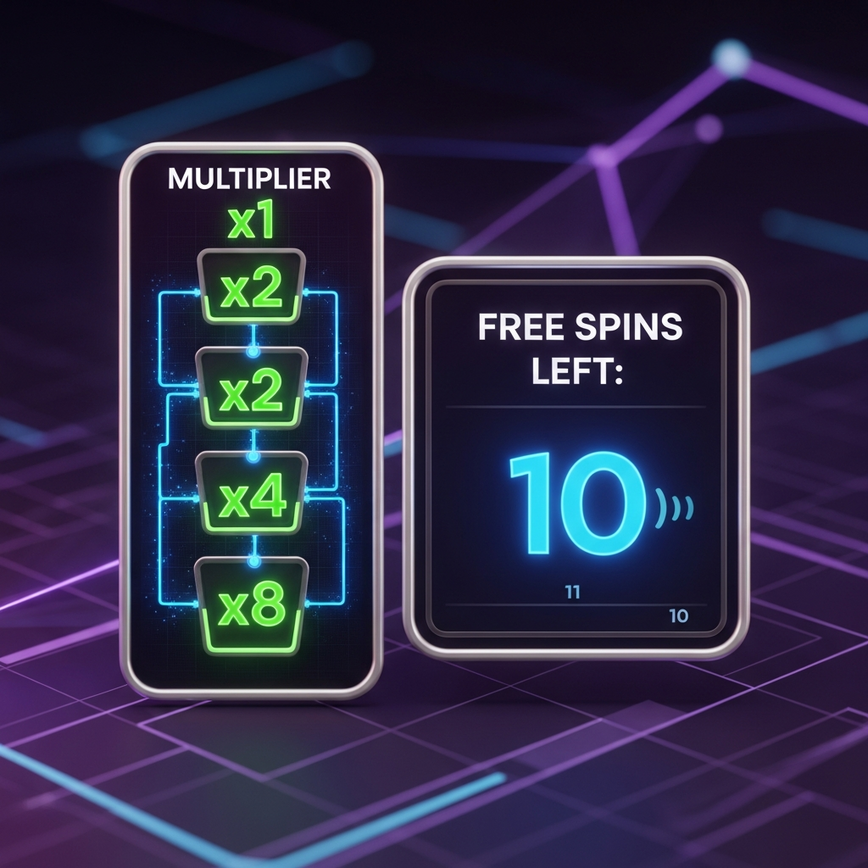
In sticky-wild titles (Fortune Tiger, Fortune Ox), wild symbols that land during free spins can stay in place for the rest of the round, often with a multiplier value attached (2×, 3×, 5× common values).
What happens when multiple sticky wilds land on the same payline: their multipliers multiply together. A 2× wild and a 3× wild on the same line make a 6× combined multiplier. Three wilds at 2×, 3×, and 5× make 30×. Theoretical maximums (10× × 10× × 10× = 1,000× on a single line) are rare but possible per the math.
Why this matters for picking sessions: sticky-wild rounds can “build up” through a free-spins set. The first 2–3 free spins might land empty multipliers, then by spin 5 you’ve got three sticky wilds locked in and the next paying spin pays at 30×. The build-up is part of the game’s pacing.
Cluster pays
Cluster-pays titles (Candy Bonanza is the headline example) replace traditional paylines with “clusters”: groups of 5 or more matching symbols connected horizontally or vertically anywhere on the grid pay out together.
The visual effect is unmistakable — the grid lights up in clumps rather than along straight lines. The math is also different: bigger clusters pay disproportionately more than smaller ones, which is part of why cluster-pays titles tend toward high volatility. A 5-symbol cluster pays modestly; a 20-symbol cluster pays enormously, and the latter is much rarer.
Cluster-pays usually combines with tumbling reels: when a cluster pays out, those symbols disappear and new ones cascade in, possibly forming another cluster. Long cascade chains in cluster-pays titles are how the very high max-win figures (like Candy Bonanza’s 21,100×) become theoretically reachable.

What the RNG actually controls (and what it doesn’t)
The RNG (random number generator) in every PGSoft title controls one thing: the symbols that appear on each spin. It’s certified by BMM Testlabs, iTech Labs, and GLI to produce statistically random output, meaning prior spin outcomes don’t predict future spin outcomes.
Things the RNG does not do:
- It does not get “hot” or “cold.” A streak of losing spins doesn’t make a winning spin more likely.
- It does not have “cycles” or “volatility shifts” that you can time. Volatility is a statistical property of the title’s math, not a state that varies during play.
- It does not give you better odds at certain times of day, on certain days of the week, or after certain events. Time-of-play does not factor into RNG output.
- It does not respond to bet size in any way that increases or decreases your edge per ringgit wagered.
If you see a guide claiming a probability number for a specific event (“1 in 287 spins triggers free spins”), treat it skeptically — PGSoft doesn’t publish those numbers for individual titles, and platform-derived stats are unreliable because the sample sizes required to estimate tail events accurately are enormous.
Using mechanics to pick your session
Practical takeaway: choose by mechanic match to your session goal.
- Long session, frequent small wins: medium-volatility, simple grid — Fortune Tiger, Lucky Neko
- Bigger wins via tumbling-reels build-up: high-volatility, tumbling-reel titles — Mahjong Ways 2, Treasures of Aztec, Wild Bandito
- Tail-of-distribution max-win hunt: cluster-pays, very high volatility — Candy Bonanza
- Free-spins compounding multipliers: titles with persistent free-spins multipliers (most of the high-volatility tier)
For the catalogue overview and which titles fit which mechanic profile, see our PGSoft pillar guide.
Important: Pirate777 is for users 18 and above. Mechanics knowledge improves how you pick titles, not your odds of winning. Set deposit limits in responsible-gaming controls if you want a hard session ceiling. Support: GamCare, BeGambleAware, GamStop.
— Pirate777 Team. We verify our observations against each studio’s own published game data and, where a studio holds one, its licence record on the regulator’s public register.
Frequently Asked Questions
Base-game multipliers apply to a single spin or cascade chain and then reset. Free-spins multipliers can persist across multiple spins within a bonus round, which is why free-spins payouts can compound spin-over-spin. The exact behaviour is title-specific — the in-game info panel is the canonical source.
Each cascade in a tumbling-reels mechanic is mathematically independent — same probability of winning combinations as the original spin. What cascades give you is the ability for a single spin to pay multiple times. Many titles also increment a multiplier per cascade (1×, 2×, 3×…), capped at a title-specific maximum.
No. Each spin is independent and the RNG doesn’t have memory. A long dry stretch doesn’t make a free-spins trigger more likely on the next spin. PGSoft doesn’t publish trigger probabilities for individual titles, and any guide that claims specific probabilities (“1 in X spins”) is either guessing or fabricating.
Not at the spin-outcome level — the RNG still controls which symbols appear. What sticky wilds do is increase the size of paylines that already win, by locking multipliers in place for the rest of a free-spins round. Two sticky wilds on a payline multiply each other (a 2× and a 3× together make 6×).
The cluster-pays mechanic plus high volatility plus long-cascade-chain potential. Most PGSoft titles cap at 2,000–5,000×. Candy Bonanza’s published 21,100× reflects the theoretical ceiling when an unusually large cluster cascades multiple times with multipliers stacking. It’s a tail-of-distribution number, not a frequent outcome.
No. The RNG doesn’t respond to time-of-day or any other external factor. Spin outcomes are independent and random. Any guide that suggests “weekend multiplier windows” or “peak-volatility hours” is making claims the math doesn’t support — and we’ve removed those claims from this guide because we couldn’t substantiate them.