



ShopeePay for Pirate777 Slots: How the In-App Ecosystem Changes the Math
If you already use the Shopee app — for groceries, food delivery, marketplace orders — you have ShopeePay. The question for slot players isn’t whether ShopeePay works on Pirate777 (it does, as one of our standard payment methods). The real question is whether ShopeePay’s particular shape — a wallet that lives inside an app you open daily for non-gaming reasons — fits the way you actually play.
This guide skips the generic e-wallet pitch and walks through the things that are genuinely specific to ShopeePay: where the transaction lives after it leaves your account, how a shared balance interacts with a slot bankroll, and the small operational quirks that only show up once you’ve used it a few times.
What’s covered
What actually makes ShopeePay different
ShopeePay is the wallet built into the Shopee app. That sounds obvious, but it has practical consequences other e-wallets don’t. With a standalone wallet — TNG, GrabPay, Boost — you open a dedicated app, top up, deposit, close the app. With ShopeePay, the wallet is one tab inside an app you open for shopping, food orders, and parcel tracking. Your slot deposit on Pirate777 sits in the same transaction list as your last grocery order.
That’s a feature for some players and a friction for others. We’ll get into both sides below.
The DuitNow QR rail underneath
When you deposit on Pirate777 via ShopeePay, the actual rail is DuitNow QR — Malaysia’s national instant payment standard. Your ShopeePay app generates the scan/pay action; DuitNow handles the routing. That’s why the deposit lands in seconds rather than waiting on a slower bank-to-bank transfer, and it’s why the same QR system works whether you scan from ShopeePay, your bank app, or another DuitNow-compatible wallet.

Shared balance vs separate wallet — the bankroll question
This is the part most ShopeePay guides skip, and it’s the part that matters most to a slot player.
If your ShopeePay balance is also the balance you use for groceries, food delivery, and marketplace orders, it isn’t a slot bankroll — it’s a general-purpose wallet that contains a slot bankroll. That changes how it should be funded.
Two ways to think about it
Pattern A — keep the balance ShopeePay-only. You don’t keep slot money in ShopeePay. When you decide to play, you top the wallet up just enough for that session (RM10 minimum, RM50 typical), deposit, play, and stop. The Shopee balance returns to roughly zero. The wallet behaves like a turnstile: money goes in, gets used, leaves.
Pattern B — keep a multi-purpose balance. You always carry a few hundred ringgit in ShopeePay because you use it for shopping. When you decide to play, the slot deposit pulls from that same pool. The line between “shopping money” and “slot money” gets blurry.
From watching how Malaysian players actually use the app, Pattern A is cleaner for anyone who treats slot play as a fixed entertainment line item. Pattern B is fine if you’re a casual player who already has good general money discipline, but it makes session limits harder to feel — you don’t see the bankroll the way you would with a standalone slot wallet.
Our platform-side deposit limits and self-exclusion tools work either way, but they’re a stronger fit if you’ve also picked Pattern A.
How a Pirate777 deposit shows up in your Shopee app
One thing players sometimes miss: when you deposit on Pirate777 via ShopeePay, the transaction logs into your regular Shopee transaction history alongside everything else you do in the app. It shows the merchant identifier and the amount; it doesn’t itemise it as “slot deposit”. For some players this is fine — the entry just looks like any other QR payment. For others, having gaming spend visible inside a shopping app is itself a useful friction point.
Withdrawals work the same way in reverse. When Pirate777 cashes a withdrawal back to your ShopeePay, the credit posts inside Shopee’s transaction list. If you scroll your Shopee history a week from now, you can reconstruct your gaming month from those entries. That’s a real audit trail without needing to keep a separate spreadsheet.
The numbers: limits, speed, fees
The platform-side numbers below apply to ShopeePay across deposit and withdrawal. They sit alongside our other supported methods (DuitNow, Touch n Go, GrabPay, FPX online banking) and follow the same baseline rules.
| Action | Pirate777 limit | Pirate777 fee | Typical timing |
|---|---|---|---|
| Deposit | RM10 minimum | RM0 | Seconds |
| Withdrawal | RM50 minimum, RM100,000 per transaction | RM0 | 2.3 minutes average |
| Daily withdrawal cap | RM10,000 across up to 3 transactions | RM0 | — |
The 2.3-minute average is from our own internal monitoring of withdrawal times between February 2025 and January 2026 — it’s a real measurement of our queue, not an industry claim. Individual withdrawals can land faster or slower depending on your bank’s link to ShopeePay and any wagering checks on the source funds.
We don’t charge a fee on either side of the transaction. ShopeePay itself doesn’t charge you to receive a payout from Pirate777. If you’ve ever paid a fee using ShopeePay it was almost certainly to top the wallet up using a credit card — that’s a Shopee/issuer charge, separate from anything that happens once funds are inside the wallet.
Wallet ceiling caveat
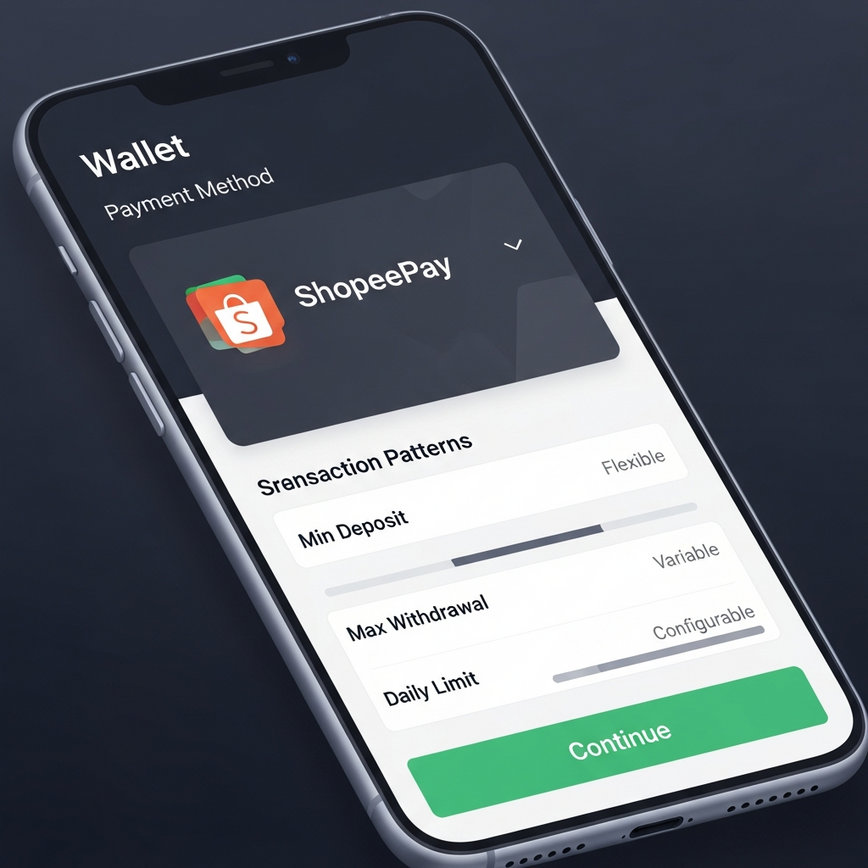
ShopeePay, like every Malaysian e-wallet, sits inside Bank Negara Malaysia’s e-money rules. Your wallet has a ceiling balance set by your KYC tier inside Shopee — Basic accounts top out lower than Premium-verified ones. If you’re planning a single large withdrawal, check your Shopee app to see your current ceiling first. Pirate777’s RM100,000 per-transaction limit doesn’t override your wallet’s own ceiling.
When ShopeePay isn’t the best fit
We try to be honest about this even though we support the method. ShopeePay is great for some patterns and worse for others.
- If you don’t already use the Shopee app for non-gaming things, the in-ecosystem advantage doesn’t apply to you. A standalone slot wallet — Touch n Go, for instance — has fewer concepts to manage.
- If you want gaming spend completely separate from your shopping app, use a different e-wallet (or DuitNow QR direct from your bank). That keeps your Shopee history shopping-only.
- If you only fund ShopeePay via credit card, credit card top-up fees can outweigh any of ShopeePay’s advantages over a direct bank transfer.
For multi-method comparisons, our e-wallet comparison guide covers TNG, GrabPay, ShopeePay, and Boost head-to-head by use case rather than by feature checklist.
Getting set up the first time
If you already have an active Shopee account, you almost certainly already have ShopeePay — it’s enabled by default. The first-time path on Pirate777 is short:
- Make sure your Shopee account has a verified phone number and a transaction PIN set. Both happen inside the Shopee app under Me → ShopeePay → Settings.
- Top up your ShopeePay balance using FPX from your bank (this is the fee-free top-up route — credit card top-ups can attract a charge).
- On Pirate777, choose ShopeePay at the deposit screen, enter an amount from RM10 upward, and scan the DuitNow QR with your Shopee app’s Pay tab.
- Confirm with PIN or biometric. Funds land in your Pirate777 wallet within seconds and are immediately playable across all of our games.
The full step-by-step is in our ShopeePay deposit tutorial. Most first-time deposits complete in under three minutes including the app-switching.
One operational note worth flagging
Mega888 and 918Kiss sit outside our single-wallet system — they’re APK-only providers and they’re excluded from promotional rolling. If you fund Pirate777 with ShopeePay and then play one of those two providers, the funding mechanic still works, but the bonus terms diverge. Worth knowing before your first deposit if you’re chasing a sign-up bonus.
18+ only. Set yourself a session budget before opening the deposit page, and use our deposit-limit tools if a multi-purpose wallet makes session control harder. BeGambleAware and GamCare have free resources if you’d like outside support.
— Pirate777 Team. We verify our observations against each studio’s own published game data and, where a studio holds one, its licence record on the regulator’s public register.
Frequently Asked Questions
No. If you have a Shopee account, ShopeePay is already active inside the same app. You only need to set a transaction PIN and verify your phone number — both done inside the Shopee app — before your first deposit.
No. We charge RM0 on both sides. ShopeePay also doesn’t charge to receive a payout. The only ShopeePay-side fees you can hit are when topping up the wallet itself with a credit card; FPX top-ups from your bank are free.
Our internal monitoring across February 2025 to January 2026 shows a 2.3-minute average from submission to funds landing in your ShopeePay. Individual withdrawals can be faster (often under a minute) or slower if there’s a wagering check on the source balance.
Not in a single transaction. Your ShopeePay ceiling is set by your KYC tier inside Shopee (Basic accounts top out lower than Premium-verified ones). If your withdrawal exceeds that ceiling, you’ll need to either upgrade your Shopee verification or take the withdrawal in two transactions across two days.
Yes. Both deposits and withdrawals post to your normal Shopee transaction list with the merchant identifier and amount. They don’t itemise as “slot deposit” — they look like any other QR payment — but the audit trail exists if you ever want to reconstruct a gaming month.
It depends on whether you already use the Shopee app for non-gaming purposes. ShopeePay is at its best when you’re already in the Shopee ecosystem; Touch n Go is a cleaner standalone wallet if you’re not. Speed, fees, and limits on Pirate777 are the same across all three.