



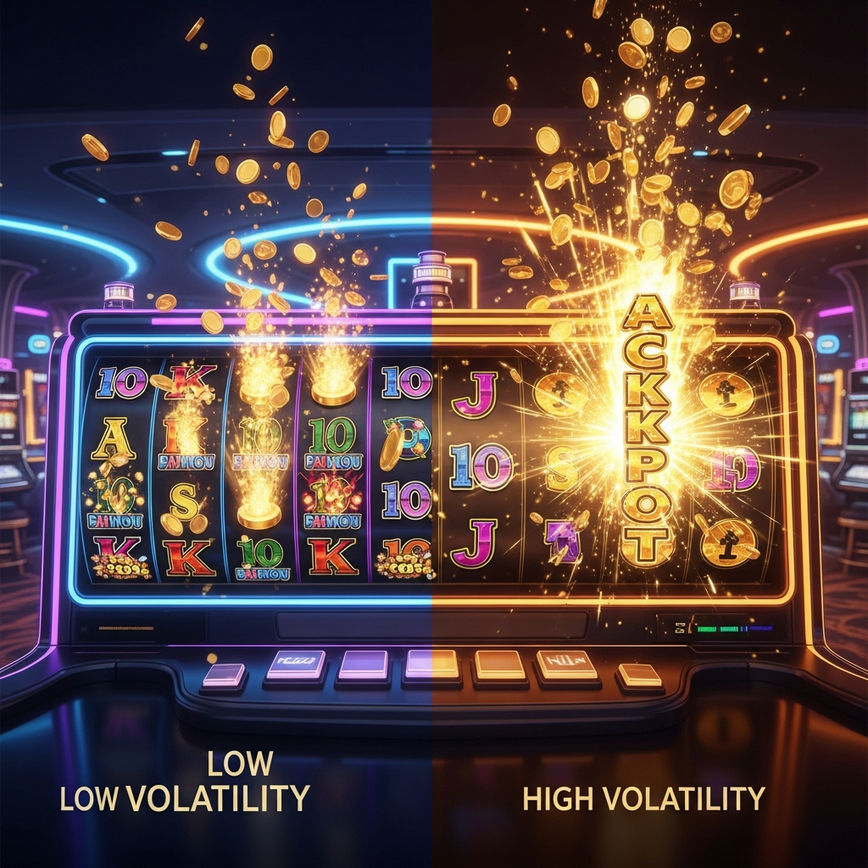
Volatility vs RTP: Why Two Slots with Similar RTP Can Feel Completely Different
RTP and volatility are two independent numbers that describe a slot — and confusing them is the single most common reason a chosen game feels “wrong” for a bankroll. RTP is the long-run return percentage. Volatility is the shape of how that return arrives. Two slots with similar RTP can deliver completely different sessions because variance, not the headline percentage, controls the rhythm.
Table of Contents
Two Numbers, One Game
Every slot you’ll play on Pirate777 has both an RTP and a volatility profile. Only one of them is printed on the card.
RTP answers the long-run question: of every RM100 wagered across millions of spins, how much comes back to players in total? On our library, certified RTPs span roughly 92% to 99%. The figure is verified by independent labs and is what shows up on the game card.
Volatility answers the short-run question: how is that return distributed? Does it arrive as many small wins, or as rare big ones? Volatility is rarely published — providers don’t certify it and the lobby doesn’t tag it. You read it from the paytable, the max-win cap, and the bonus mechanic. The pillar primer covers both numbers and where each comes from.
The Math: Two 96% Slots, Two Different Sessions
Here’s the cleanest way to see why same-RTP slots feel different. Imagine two RM1-per-spin games, both with 96% RTP, both perfectly fair. Over a million spins they each return RM960,000 on a million RM bet. Identical math.
Now zoom into a 100-spin session.
Slot A — low variance: pays a small win on roughly 1 in 3 spins, average win around RM0.50, occasional RM2 hit. Across 100 spins you might see 30 wins for a total around RM96. Your balance ticks up and down in small steps and you almost certainly walk away with most of your stake intact.
Slot B — high variance: pays nothing on most spins. After 100 spins you might have collected around RM30 in small line wins and walked into one bonus that paid RM66. Or you might have walked into nothing and lost the full RM100. Across thousands of sessions the average still resolves to RM96 returned per RM100 wagered, but inside any single session the swing is wide.
That’s the entire trick. The RTP doesn’t change. The shape of the distribution does, and the shape is what you experience.
What “Feels Different” Actually Means
The phrase “the slot feels different” usually decomposes into three concrete differences:
- Hit frequency — what fraction of spins return any win at all. Low-variance slots hit often; high-variance slots stay quiet for long stretches.
- Win-size shape — when wins do land, how big they tend to be. Low variance clusters wins tightly around small values; high variance produces a long tail with rare big payouts.
- Bonus pacing — how often features trigger. High-variance slots make you wait for the bonus and then deliver most of the session value when it lands.
None of these are explicit in the RTP figure. All three are baked into the volatility shape.
RTP and Volatility Are Independent
This trips up almost everyone the first time they see it: RTP and volatility don’t move together. You can find:
- High RTP + low volatility — steady drip of small wins, long sessions, modest peaks.
- High RTP + high volatility — long quiet stretches punctuated by rare big hits; session can feel either thrilling or grinding depending on luck.
- Low RTP + low volatility — wins flow but the long-run cost is higher. Less common as design choice.
- Low RTP + high volatility — rare wins and a higher house edge. Worst-of-both for most players.
A slot at 97% RTP can be more punishing in a single session than a slot at 94% RTP, if the 97% game’s volatility is much higher and you’re playing for an hour. Long-run, the 97% game is mathematically better. Short-run, the 94% game might pay you more often along the way.
Spotting the Difference Before You Play
You don’t need to play 200 spins to estimate volatility. Three paytable reads catch most of the signal:
- The premium-to-low-symbol payout gap. Wide gap (50x+) signals high variance; narrow gap (5–10x) signals low variance.
- The max-win cap. A 5,000x advertised maximum signals high variance — the math has to make room for that headline payout. A 500x cap signals low variance.
- The bonus mechanic. Multi-stage bonuses with multipliers and retriggers indicate higher variance. Simple fixed-multiplier free spins indicate lower variance.
Combine all three and you have a reliable read in under a minute, before any money moves. The full paytable + first-spin reading technique drills into each signal individually.
Three Common Confusions
“Higher RTP means I’ll win more often.” No. Higher RTP means the long-run house edge is smaller. Win frequency is controlled by volatility. A 97% RTP high-variance slot will still produce long losing streaks.
“Volatility evens out within a session.” Not in any session you’ll actually play. RTP is a millions-of-spins average; volatility shapes the short-run experience. A 30-minute session of 200 spins is essentially a coin-flip noise sample by RTP standards.
“A slot is ‘due’ for a bonus after a dry stretch.” Each spin uses a certified RNG and is independent. Long quiet stretches are exactly what high variance produces — they don’t make a bonus more likely on the next spin.
Staying Safe While You Learn
The cleanest way to learn the difference between volatility profiles is to probe at minimum bet for 50 spins on any new slot before sizing up. That bounded test costs little and teaches more than reading about it. If gambling is causing harm, support is available through BeGambleAware, including limit-setting tools and direct help. Pirate777 is for players aged 18 and above; deposit and session limits are available in your account.
— Pirate777 Team. Certification background and full RG resource list live on the pillar primer.
Frequently Asked Questions
RTP is the long-run average return. Volatility is the shape of how that return is distributed. A low-variance 96% slot pays small wins often and your balance ticks up and down in small steps. A high-variance 96% slot pays nothing for long stretches and then drops a big hit. Same long-run math, completely different short-run experience.
Steadiness is a volatility property, not an RTP property. A 94% RTP low-variance slot will pay more steadily than a 97% RTP high-variance slot in a single session. Look for low variance first (small paytable gap, low max-win cap, simple bonus), then prefer the higher RTP among low-variance options if you have the choice.
Yes. RTP and volatility are independent — every combination exists in the design space. You can find high-RTP low-variance slots (steady drip with a smaller long-run house edge), high-RTP high-variance ones, and so on. Don’t assume one number predicts the other.
No. The RTP percentage is an average over millions of spins. The probability of a winning spin (hit frequency) is set by volatility. A 97% RTP slot can still have a 10% hit frequency if it’s high variance — most spins return nothing.
Volatility, by a lot. RTP only stabilises across millions of spins; a single 30-minute session is too short for the average to assert itself. Volatility, on the other hand, controls exactly what your session feels like — hit frequency, win sizes, bonus pacing. Pick volatility for your session goal first, then prefer the higher RTP within that band.