



When a Withdrawal Takes Longer: Checks Before Approval, Weekends, Holidays and What to Do
Pirate777’s published average for withdrawals is 2.3 minutes — timed from the moment a withdrawal is approved to the moment the receiving bank credits your account. It is an average, not a promise, and some withdrawals take longer to reach you. This article goes through the reasons, what each one means for you, and when to contact Captain’s Support. Withdrawals are currently paid by DuitNow bank transfer to your registered bank account; e-wallet withdrawals are temporarily unavailable (as of 26 August 2026). We update this page when that changes.
What the 2.3 minutes covers, and what it doesn’t
The 2.3-minute figure is an average from our own records, kept by our finance team as internal operational monitoring — not a controlled study, and not externally audited. It was timed in one-hour sessions on randomly chosen days and times across February 2025 – January 2026, and measured again in March – April 2026, when the average held. The withdrawal architecture explainer sets out the four steps of a withdrawal:
- You submit the request — the withdrawal bank (from the banks you have registered), the account number and the amount.
- Checks before approval — the checks our Terms require, covered below.
- Approval — the clock starts.
- Bank credit — the clock stops when the receiving bank credits your account.
Only steps 3 and 4 are inside the 2.3 minutes. The checks at step 2 happen before the clock starts: they can make a withdrawal take longer to reach you, but they are not part of the average. The sections below take these one at a time, along with the other reasons a withdrawal can be late.
Your first withdrawal: the identity check
The identity check happens during your first withdrawal and is handled by Captain’s Support. Our Terms (section 2.2) list what you may be asked for: a government-issued ID — MyKad, passport or driving licence — and a selfie holding that ID.
Our Terms put a standard check at 15 minutes to 2 hours, and up to 5 business days for complex cases that need more review. The check comes before approval, so this time is not part of the 2.3-minute average.
It is not a one-time step. Our Terms allow the check again on a single withdrawal above RM5,000, when withdrawals pass RM20,000 within 30 days, when our security team flags unusual activity, or at random as part of compliance audits. Those thresholds are Pirate777’s own policy, and a check at those amounts is a routine step, not an accusation. For large withdrawals, you may also be asked where the funds came from.
Withdrawal limits
The minimum withdrawal is RM50, and the maximum is RM100,000 per withdrawal, within your daily limit. At the entry rank the daily limit is RM10,000 across up to 3 withdrawals; the daily amount and the number of withdrawals both rise with rank. The large-withdrawals guide covers amounts above your daily limit.
Turnover still to complete
Our Terms require every deposit to be wagered at least once before you withdraw, whether or not you took a bonus. A withdrawal requested straight after a deposit, with no play in between, is rejected.
If you claimed a bonus, its turnover must be completed first: (bonus + deposit) × the multiplier the offer names. Games from Mega888 and 918Kiss do not count toward promotional turnover. If you are not sure how much turnover is left, ask Captain’s Support.
A security check on a new device
Using a new device can bring a verification step, by text message (SMS) or by email. If you receive a verification message you did not expect, contact Captain’s Support.
System maintenance
Maintenance can delay a withdrawal. It is announced 15 minutes before it starts, in the members area — you see the notice once you are logged in. Our Terms (section 10.5) list emergency maintenance among the events that can delay a payout, and say pending withdrawals are honoured once systems are restored.
Weekends and public holidays
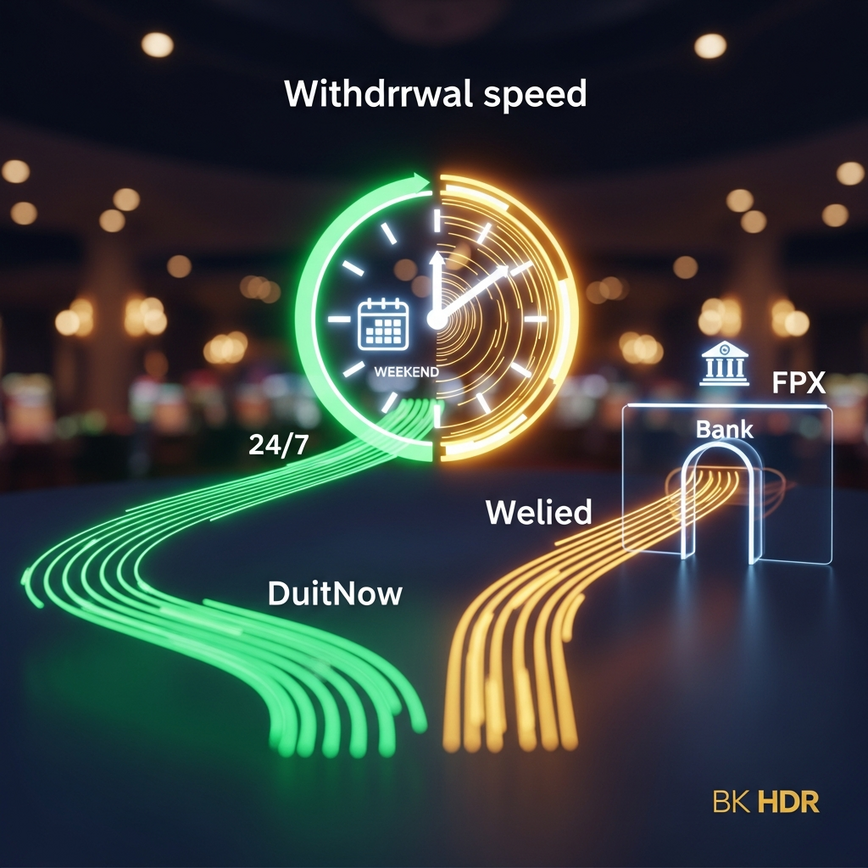
Withdrawals are approved around the clock, and DuitNow itself runs 24/7. The 2.3-minute figure is a daily average across all seven days, so weekends are inside it. It has never been split by day of the week, by public holiday or by time of day, so we have no separate weekend or holiday figure and make no claim that any day or hour is faster or slower.
Bank cut-off times belong to a different rail, Interbank GIRO (IBG). Under PayNet’s clearing schedule, an IBG transfer submitted Monday to Friday before 5pm is credited the same day, and one submitted after 5pm, at the weekend or on a public holiday is credited the next business day. No Pirate777 withdrawal travels on IBG.
Your bank’s app showing the credit late
The clock stops when the receiving bank credits your account, not when your banking app shows it. Some banks’ apps show an incoming DuitNow credit later than others. The Pirate777 app can also send a “Withdrawal Successful” in-app notice (you can switch it on or off in Settings).
A payout that does not go through
If a withdrawal cannot be paid into the account — for example, the account is closed or the account number is wrong — the money comes back to your Pirate777 wallet. How long that takes depends on the payment provider handling the transfer. To correct your bank details and withdraw again, contact Captain’s Support.
Withdrawals are paid only to a Malaysian bank account in your own name; this is one of the checks before approval.
What to do if your withdrawal has not arrived
There is no live withdrawal status tracker. If a withdrawal has not reached your bank 15 minutes after you submitted it, you can contact Captain’s Support at any time — 24/7 on Telegram or in-app Live Chat — and ask what is happening with it. On a first withdrawal, allow for the identity check above, which our Terms put at 15 minutes to 2 hours. It helps to have ready:
- the amount and the time you submitted the withdrawal;
- the withdrawal bank and account number you chose;
- a screenshot of any error message.
The stuck-withdrawal triage guide covers what to check first.
Related guides
- Inside the 2.3-minute average: how Pirate777’s withdrawal architecture actually works — the four steps of a withdrawal and where the clock runs
- My slot withdrawal is stuck: triage steps before contacting Captain’s Support — symptom-first troubleshooting
- Large withdrawals in Malaysia: splits, identity checks and rank tiers — for amounts above the standard caps
- How to withdraw from Pirate777: bank payout, limits and rank tiers — the step-by-step walkthrough
Frequently Asked Questions
No. The identity check happens during your first withdrawal, before approval, and the 2.3-minute average starts at approval. Our Terms put a standard check at 15 minutes to 2 hours, and up to 5 business days for complex cases.
Our own Terms set it: a single withdrawal above RM5,000, or withdrawals passing RM20,000 within 30 days. A check can also happen when our security team flags unusual activity, or at random as part of compliance audits.
A withdrawal is approved only after the checks our Terms require: the identity check on a first withdrawal, every deposit wagered at least once, and any bonus turnover completed. There is no live status tracker, so if it has not been paid 15 minutes after you submitted it, ask Captain’s Support — 24/7 on Telegram or in-app Live Chat.
We have no separate weekend figure. The 2.3-minute average is a daily average across all seven days, so weekends are inside it, and it has never been split by day. Withdrawals are approved around the clock, and DuitNow runs 24/7.
We have no public-holiday figure: the 2.3-minute average is a daily average across all seven days and has never been split by day. Withdrawals are approved around the clock, and DuitNow itself runs 24/7. The next-business-day rule applies to Interbank GIRO (IBG) transfers, and no Pirate777 withdrawal travels on IBG.
It comes back to your Pirate777 wallet. How long that takes depends on the payment provider handling the transfer. Contact Captain’s Support to correct your bank details and withdraw again.
System maintenance can delay a withdrawal. It is announced 15 minutes before it starts, in the members area after you log in, and our Terms (section 10.5) say pending withdrawals are honoured once systems are restored.
18+ only. Play within your limits, and only with money you can afford to lose. If gambling is causing you difficulty, free and confidential help is available from BeGambleAware, and deposit limits, cool-off periods and self-exclusion are set by contacting Captain’s Support. — Pirate777 Team