




eWallet Speed Test: DuitNow vs TnG vs GrabPay vs ShopeePay for Slot Deposits
In our own operational records for February 2025 to January 2026, a DuitNow QR deposit credited a Pirate777 account in 30–60 seconds; a Touch ‘n Go eWallet deposit in 1–3 minutes; GrabPay in 2–4 minutes; ShopeePay in 2–6 minutes. Success rates from the same records run in the same order: 99.2%, 98.8%, 97.5%, 96.8%. That is the whole speed test — four routes, one record window, no stopwatch on individual sessions. The gap has a mechanical reason, not a marketing one: a DuitNow QR carries the amount and the payment reference inside the code and credits on the national real-time rail, while a wallet payment is approved inside the wallet’s own app and reaches us as a confirmation from its gateway. What the records do not contain — hour-by-hour patterns, peak-time slowdowns, per-amount verification thresholds — this page no longer claims. Every route takes RM10 minimum, and none of it changes how you are paid out: withdrawals are currently paid by DuitNow bank transfer to your registered bank account (e-wallet withdrawals temporarily unavailable as of 26 August 2026).
Table of Contents
- What Did Our Records Show for Each Deposit Route?
- Why Does DuitNow QR Credit Faster Than a Wallet?
- Speed Test Results: The Table
- What Actually Delays a Deposit?
- How Do You Get the Fastest Credit?
- What Did We Not Measure?
- What Happens Between Your App and Your Balance?
- Responsible Gaming and Payment Management
What Did Our Records Show for Each Deposit Route?
The figures on this page come from Pirate777’s own operational records for February 2025 to January 2026 — the time between a deposit being confirmed on the payment side and the coins appearing in the player’s wallet, and the share of attempted payments that completed. They are operational records, not a controlled experiment: we did not stopwatch chosen sessions, and we publish ranges rather than medians because a range is what the records support. The illustration below is a mock-up; the numbers in the text are the ones to quote.
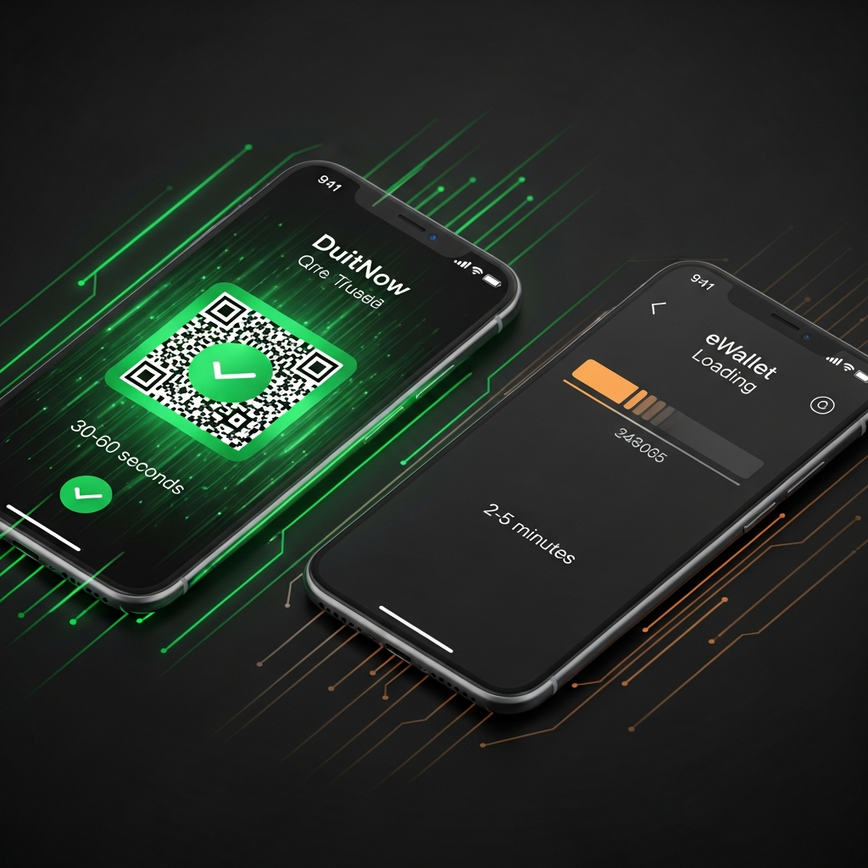
DuitNow QR credited in 30–60 seconds with a 99.2% success rate — the fastest and the most reliable route in the records. It is the route the cashier opened first under E-Wallet on our 24 August 2026 read: a payment window shows a QR generated for that deposit, you scan it in any Malaysian banking or e-wallet app that supports DuitNow QR, the app shows the recipient name, and you authorise with your own PIN or biometrics. Up to RM50,000 per transaction.
Touch ‘n Go eWallet credited in 1–3 minutes with a 98.8% success rate. The cashier redirects you to TnG’s gateway page, where you enter your registered mobile number and six-digit PIN; the coins are credited when TnG’s confirmation reaches us. RM10 to RM5,000 per transaction. The TnG tutorial has the screens.
GrabPay credited in 2–4 minutes with a 97.5% success rate, approved inside the Grab app with your GrabPay PIN or biometrics. RM10 to RM5,000 per transaction. The GrabPay tutorial walks through it.
ShopeePay credited in 2–6 minutes with a 96.8% success rate, approved inside the Shopee app. RM10 to RM5,000 per transaction; the ShopeePay walkthrough covers the six ways it goes wrong.
Two routes are on the roster but not in this test. Boost is a deposit route we hold no crediting record for, so we publish no figure. Telco and TnG reload PINs are the slow route by design: the PIN is typed in, the cashier prices it on its own rate line (a RM100 TnG reload PIN credited RM89 and a RM100 telco PIN credited RM72.50 on our 24 August 2026 read), and the amount must match the PIN’s face value; telco-PIN deposits earn the “Top up with Telco Pin, get 5% bonus” promotion with no turnover. The RM10 page sets those rates out in full.
Why Does DuitNow QR Credit Faster Than a Wallet?
The gap is structural, and it has nothing to do with Pirate777 being “integrated with PayNet” — we are not a participant on the rail and do not claim to be. A DuitNow payment reaches us the way it reaches any online merchant: through a payment gateway that shows a QR for that deposit. What the QR does is remove the two things that take time on every other route.
- The reference travels inside the code. A DuitNow QR carries the amount and the transaction reference that ties the payment to your account. Nothing is typed, so nothing is mistyped, and the payment arrives already matched. A wallet deposit is matched on the gateway’s confirmation instead, which is one more round trip.
- The credit is real-time on the rail. DuitNow settles on PayNet’s Real-time Retail Payments Platform, so the paying bank’s confirmation is available within seconds of you authorising. A wallet payment is settled inside the wallet operator’s own system first and confirmed to us afterwards; how long that takes is the wallet’s side, and it is why the wallet ranges start at a minute rather than at 30 seconds.
- The wallet ranges differ from each other for reasons we cannot see. TnG, GrabPay and ShopeePay each run their own approval and confirmation flow, and none of them publishes its internals. The earlier version of this page explained the ranking with “fraud detection layers”, “risk engines” and “e-commerce traffic”; those were guesses dressed as findings, and they are gone. The ranges are what we recorded; the explanation for the order between wallets is not something we can offer honestly.
What every route shares: the coins land in one Pirate777 wallet at one coin per ringgit, usable across 2,500+ titles from every studio in the library, with no transfer between game wallets before you play.
Speed Test Results: The Table
| Route | Credited (records) | Success rate (records) | Per transaction | Where you authorise |
|---|---|---|---|---|
| DuitNow QR | 30–60 seconds | 99.2% | RM10 – RM50,000 | Your own banking or e-wallet app, after it shows the recipient name |
| Touch ‘n Go eWallet | 1–3 minutes | 98.8% | RM10 – RM5,000 | TnG’s gateway page, six-digit PIN |
| GrabPay | 2–4 minutes | 97.5% | RM10 – RM5,000 | Grab app, PIN or biometrics |
| ShopeePay | 2–6 minutes | 96.8% | RM10 – RM5,000 | Shopee app, PIN or biometrics |
| Boost | No record — no figure published | No record | RM10 minimum; cap shown by the cashier | Boost app, PIN |
| Telco / TnG reload PIN | Not timed — credits below face value | No record | PIN face value | Typed into the cashier |
Payment methods, limits and crediting records last verified 26 August 2026. We update this page when they change.
The “industry comparison” column that used to sit in this table is gone. The 15–45-minute spread it compared against is our own timing of competitors’ withdrawals (173 timed withdrawals across 98 Malaysian platforms), which has nothing to do with deposit crediting; multiplying a deposit time against a withdrawal benchmark produced numbers like “20–30x faster” that measured nothing. That benchmark lives where it belongs, on the withdrawal speed test.
What Actually Delays a Deposit?
Almost never the rail, and never the hour. The causes we actually see are short and specific.
- Declined at the gateway. A wallet limit, a verification tier on your wallet, a wrong PIN, or an amount above the route’s cap. Nothing leaves your wallet; the cause and the fix are in the wallet app.
- A manual transfer without the reference. Money sent by ordinary bank transfer to the account the cashier displays arrives with nothing to match it to you, and has to be matched by hand from your receipt. This is the single most common “my deposit is missing” case, and it is the reason the QR route is faster: the reference is inside the code.
- A timed-out payment window. The window closed before you confirmed; nothing moved. Start again from the cashier.
- A reload PIN whose amount does not match. The cashier warns that the amount entered must equal the PIN’s face value; a mismatch is rejected rather than partially credited.
- Your own connection. A payment approved on a poor connection can leave the wallet before the confirmation reaches the gateway. The payment is not lost; it is matched once the confirmation arrives or from your receipt.
Two things this page used to blame are not on that list. Deposits above a threshold do not go through an “enhanced security check” that we can point to: the records show no per-amount effect, and the deposit that needs a manual look is the one that arrives with nothing to match it to your account — a transfer made outside the payment window. And there is no 7–9 PM slowdown in the records, because the records were never cut by hour — see below.
How Do You Get the Fastest Credit?
- Pay through the cashier’s window, every time. Amount first, Buy, then the method. The window carries the reference; a transfer made outside it does not.
- Use DuitNow QR when you want the fastest credit or an amount above RM5,000. Scan it from your bank app; the amount and recipient are already inside the code. Check the recipient name the app shows before you confirm.
- Use the wallet you already hold a balance in. Topping up a wallet from your bank and then paying from it is two steps; if the money is already in your bank, the QR is one. The wallet comparison weighs TnG, GrabPay and Boost on the deposit side.
- Keep the receipt. The transaction ID is the one thing that turns a slow case into a quick one if a deposit needs matching by hand.
- Do not wait for an “off-peak” window. We have no data that any hour credits faster, and the rail is real-time around the clock.
What Did We Not Measure?
A speed test is only as honest as its boundaries, so here are the ones this page respects. No hourly split: the records are not cut by time of day, so every claim the old page made about 7–9 PM, 6–8 AM or weekend windows was invented and has been removed. No median or peak figures: we publish the range the records support, not an “under 30 seconds at peak” that we never separated out. No per-amount effect: the records do not show deposits above RM100 or RM500 crediting more slowly, and we no longer say they do. No Boost figure: it is on the roster and outside the records. No per-wallet withdrawal time: withdrawals were never timed by destination, and today they are paid by DuitNow bank transfer to your registered bank account only, with e-wallet withdrawals temporarily unavailable as of 26 August 2026; the 2.3-minute withdrawal average is our finance team’s end-to-end timing across one measured population, replicated in two windows fourteen months apart, and it is a withdrawal figure, not a deposit one.
What Happens Between Your App and Your Balance?

The cashier does not talk to your bank or your wallet directly, and it never sees your login. It hands you to a payment window — a QR for DuitNow, TnG’s own gateway page for Touch ‘n Go, or a prompt in the Grab or Shopee app — and what comes back is a confirmation that a payment of that amount was made. The coins are credited on that confirmation. Your banking password, card number and wallet PIN stay inside your own app; the connection between your phone and our site is 256-bit SSL encrypted, the same standard Malaysian banks use for web banking. The tablet above is a mock-up, not the cashier: on our 24 and 26 August 2026 reads the method menu listed E-Wallet, FPX Pay and Telco + TNG Reload, and the wallet routes appear inside it as the cashier and its processor surface them at that moment.
Once credited, the money is in a single wallet across every studio — Pragmatic Play, PG Soft, Jili, Playtech, Mega888, 918Kiss and the rest — so there is no second transfer before you play and nothing to move back before you withdraw. The one direction rule worth carrying with you: a DuitNow QR only ever takes money from the person scanning it. Scan the code the cashier shows you while you are logged in, and never one sent to you by message, however official it looks; a request to scan a QR to “receive” a bonus or a withdrawal is a scam, and the National Scam Response Centre is on 997.
Responsible Gaming and Payment Management
A fast credit is a convenience, and the faster it is the more a deposit limit matters. At Pirate777 deposit limits, time-outs and self-exclusion are arranged by asking Captain’s Support, as our responsible gaming policy sets out; for support outside the platform we point players to GamCare and BeGambleAware. This platform is for players aged 18 and above. Only ever deposit what you can afford to lose, and let the speed of the rail serve a budget you set first.
— Pirate777 Team. Deposit crediting times and success rates on this page are our own operational records for February 2025 to January 2026, published as ranges because that is what the records support; the 2.3-minute withdrawal figure is our finance team’s own end-to-end timing in two windows fourteen months apart. Cashier observations, reload-PIN rates, limits and the withdrawal status are dated in the text. We do not describe any wallet operator’s internal systems because we cannot verify them.
Frequently Asked Questions
At Pirate777, DuitNow QR — strictly a bank route rather than an e-wallet: in our records for February 2025 to January 2026 it credited in 30–60 seconds with a 99.2% success rate. Of the wallets proper, Touch ‘n Go eWallet was fastest at 1–3 minutes (98.8%), then GrabPay at 2–4 minutes (97.5%) and ShopeePay at 2–6 minutes (96.8%). We hold no record for Boost and publish no figure for it.
30–60 seconds in our records, from the moment your bank confirms the payment. The QR carries the amount and the reference, so the payment arrives already matched to your account and credits on the real-time rail. If a QR deposit has not appeared after a few minutes, it is almost always because the money was sent by manual transfer instead of through the code; send the transaction ID from your bank receipt to Captain’s Support and it is matched by hand.
In our records, 30–60 seconds against 1–3 minutes. The difference is where the payment is confirmed: a DuitNow QR credits on the national real-time rail with the reference inside the code, while a TnG payment is approved on TnG’s gateway and confirmed to us afterwards. Both are free, both take RM10 minimum, and TnG caps at RM5,000 per transaction against RM50,000 for DuitNow QR.
The recorded ranges are 2–4 minutes for GrabPay and 2–6 for ShopeePay, so a few minutes is normal. Beyond that, the usual causes are a payment declined inside the wallet app (nothing has left your balance), a timed-out payment window (nothing moved; start again), or a manual transfer made outside the cashier’s window, which arrives without a reference and has to be matched by hand from your receipt. We have no data showing that the time of day or the amount changes the range.
Pay through the cashier’s own window so the reference travels with the payment; use DuitNow QR from your bank app when speed matters most; use the wallet you already hold a balance in rather than topping one up first; and keep the receipt. There is no faster hour to deposit — the rail is real-time around the clock, and our records were never cut by time of day.
RM10 on every route — DuitNow QR, Touch ‘n Go eWallet, GrabPay, ShopeePay, Boost, FPX online banking and reload PINs. The caps differ: RM50,000 per transaction on DuitNow QR and RM5,000 on TnG, GrabPay and ShopeePay. A RM10 deposit buys the same library and the same wallet as any larger one; the RM10 page explains what it does and does not get.
Withdrawals. The 2.3-minute average is our finance team’s own end-to-end timing of withdrawals, from approval to bank credit, replicated in two windows fourteen months apart; it has nothing to do with the deposit crediting times on this page. Withdrawals are currently paid by DuitNow bank transfer to your registered bank account; e-wallet withdrawals are temporarily unavailable (as of 26 August 2026), and we update this page when that changes.